
LevelFields AI Review: Event-Driven Stock Alerts Before You Pay
This LevelFields AI review looks at what traders should check before paying for event-driven stock alerts, AI stock analysis, or a stock event scanner.
LevelFields AI appears to position itself as an AI-powered platform that monitors company events and helps traders find stock opportunities connected to real-world catalysts.
That is a different angle from a normal stock signal app.
Instead of only scanning charts or price alerts, LevelFields focuses more on events such as company news, earnings-related moves, buybacks, leadership changes, FDA developments, guidance, and other catalysts that may affect stock prices.
That can be useful.
But event-driven stock alerts are not automatic trade signals.
Traders still need to check timing, market reaction, liquidity, risk, pricing, win-rate claims, and whether the alert arrives early enough to be useful.
This article is not financial advice and it is not a recommendation to use or avoid LevelFields AI. The goal is to review what is publicly visible, what is unclear, and what traders should verify before paying.
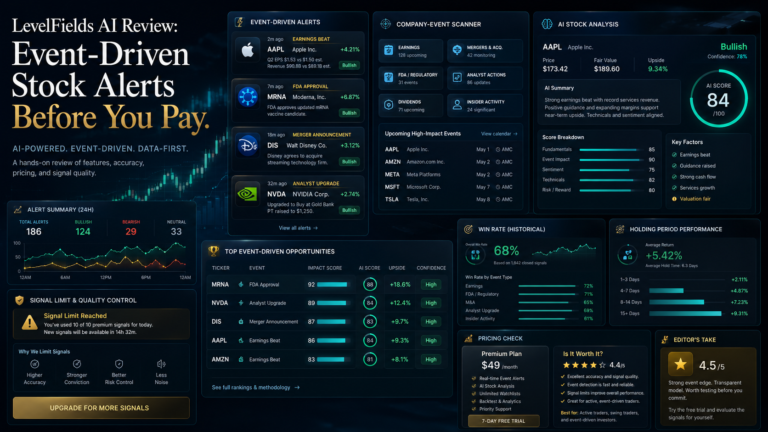
LevelFields AI Review: What Traders Should Check First
A LevelFields AI review should start with a simple question:
Does the platform help traders act on events, or does it only show interesting news after the move?
That question matters because event-driven trading depends heavily on timing.
If an alert arrives after the stock already moved, the opportunity may be weaker. If the event is misunderstood, the trader may react in the wrong direction. If the stock has poor liquidity, even a useful alert can be hard to trade.
Before paying for an AI stock analysis tool, traders should check whether the platform gives enough context around each event.
What This Article Checks
This article checks LevelFields AI from a practical review perspective.
The main checks are:
event-driven stock alerts
AI stock alerts
stock event scanner quality
pricing clarity
trial or refund terms
whether win-rate data is explained
whether alerts are early or late
whether the tool is a signal service, scanner, research app, or AI dashboard
whether traders can understand why an event matters
whether the tool helps decision-making or creates more alert noise
These checks matter because event-driven stock alerts can look powerful, but the trader still has to judge the setup.
What LevelFields AI Appears to Offer
LevelFields AI appears to focus on event-driven stock analysis.
The platform describes monitoring thousands of companies and using AI to identify events that may affect stock prices. Public pages also describe event alerts, price reactions, entries, exits, and win-rate style data.
That makes LevelFields different from a basic stock alert app.
A simple alert app may notify traders when a stock hits a price.
A charting platform may notify traders when a technical pattern appears.
An event-driven stock scanner tries to detect company or market events that may explain why a stock is moving.
That can include events such as:
earnings surprises
guidance changes
buybacks
management changes
FDA updates
analyst actions
legal or regulatory events
merger activity
sector-specific catalysts
The value depends on whether the alert is timely, understandable, and supported by enough context.
Event-Driven Stock Alerts: Useful, But Not Automatic Signals
Event-driven stock alerts can be helpful because markets often react to real company events.
But an event is not automatically a trade.
A buyback announcement may be bullish in one context and ignored in another. An earnings beat may still lead to a selloff if guidance disappoints. A leadership change may excite investors or create uncertainty. FDA news may move a biotech stock sharply, but risk can remain high.
That is why traders should not treat event-driven alerts as automatic stock signals.
They should ask:
What happened?
When did it happen?
Did the stock already react?
Is the reaction likely overextended?
Is there enough volume and liquidity?
Is the event positive, negative, or mixed?
Does the platform show historical reactions to similar events?
Is there a clear risk plan?
A strong event alert should help traders understand the situation, not just tell them that something happened.
AI Stock Analysis Still Needs Context
AI stock alerts can help traders process information faster, but AI does not remove market uncertainty.
An AI stock analysis tool may help scan news, filings, press releases, company events, and price reactions. That can reduce manual work.
But AI should still be reviewed carefully.
Traders should check:
Does the platform explain why an event matters?
Does it show past examples?
Does it show failed events?
Does it separate short-term alerts from long-term research?
Does it explain win-rate data clearly?
Does it show how entries and exits are generated?
Does it include risk controls?
If the platform shows win-rate style data, traders should ask how the number is calculated and whether losing examples are included.
A percentage without context can mislead traders.
Who LevelFields AI May Fit
LevelFields AI may fit traders or investors who want to follow real-world stock events instead of only chart patterns.
It may appeal to users who care about:
U.S. stock catalysts
company-event alerts
AI stock analysis
event-driven trading ideas
earnings reactions
buybacks and management changes
news-driven stock movement
watchlist monitoring
It may not fit traders who only want simple buy and sell signals, crypto alerts, forex signals, or options-flow scanning.
It may also not fit users who do not want to interpret event context themselves.
The tool may surface events, but traders still need to decide whether the event is actionable.
Red Flags Traders Should Verify Before Paying
Before paying for LevelFields AI or any event-driven stock alert platform, traders should check these areas.
1. Alert Timing
Does the alert arrive before the move, during the move, or after the main move has already happened?
2. Event Context
Does the platform explain why the event matters?
3. Win-Rate Data
If win rates are shown, are dates, sample size, event type, and calculation method clear?
4. Failed Examples
Can users see events that did not work or only successful examples?
5. Pricing and Plan Limits
Are pricing, trial terms, feature limits, and cancellation rules easy to find?
6. Market Fit
Does the tool cover the stocks, sectors, and event types the trader actually follows?
7. Risk Controls
Does the platform help users think about exits, position size, volatility, and what happens if the event reaction fails?
If these answers are unclear, traders should slow down before treating any AI event alert as a signal.
FAQ: LevelFields AI Review
What is LevelFields AI?
LevelFields AI appears to be an AI-powered stock analysis platform focused on detecting company events and providing event-driven stock alerts.
Is LevelFields AI a stock signal service?
LevelFields AI is better understood as an event-driven stock scanner and AI stock analysis tool. Traders should verify whether alerts include enough context before treating them as signals.
Are event-driven stock alerts reliable?
Event-driven stock alerts can be useful, but they are not automatically reliable. Traders should check timing, event context, liquidity, historical examples, failed alerts, and risk controls.
What should traders check before paying for LevelFields AI?
Traders should check pricing, trial access, alert timing, event coverage, win-rate calculation, failed examples, and whether the platform fits their market and trading style.
Is LevelFields AI only for day traders?
Not necessarily. Event-driven stock alerts may appeal to day traders, swing traders, and investors, depending on the event type, alert timing, and how the user applies the information.
Final Thoughts
LevelFields AI is interesting because it focuses on event-driven stock alerts rather than only chart patterns or basic price notifications.
That can be useful for traders who want to follow real company catalysts.
But event-driven alerts still need proof and context.
An event is a clue.
An AI alert is a clue.
A win-rate number is a claim.
A stock reaction still needs risk management.
Before paying for LevelFields AI, traders should check alert timing, event context, pricing, win-rate data, failed examples, and whether the platform shows enough detail to support real decisions.
If LevelFields AI or another provider believes any information is outdated or incomplete, they can contact AISignalsBot with public proof, updated terms, or a reviewable product update.
For more comparison-led articles, use the Market Insights & Trading Signal Guides hub. If there is an AI stock analysis tool, event scanner, signal app, or trading platform AISignalsBot should review, suggest it through the contact page.