
MQL5 Signals Review: Copy Trading Stats, Drawdown and Proof Checks
This MQL5 Signals review walks through the questions a trader should answer before copying a MetaTrader provider, paying for a copy trading subscription, or taking a set of published stats at face value.
MQL5 Signals is not a Telegram channel with alerts and screenshots. It is a marketplace built into the MetaTrader ecosystem where providers publish trading history, growth curves, drawdown figures and subscription terms so traders can compare accounts side by side. For the wider comparison, see MetaTrader signals vs Telegram signals.
Having more data on screen is not the same as having less risk. A profile can post an impressive equity curve and still be quietly carrying leverage, deep drawdown, or a handful of open trades that have not yet been closed at a loss.
Nothing here is financial advice or an endorsement of any specific provider. The purpose of this MQL5 Signals review is to point out what is visible, what is missing, and what deserves a second look before anyone connects a live account.
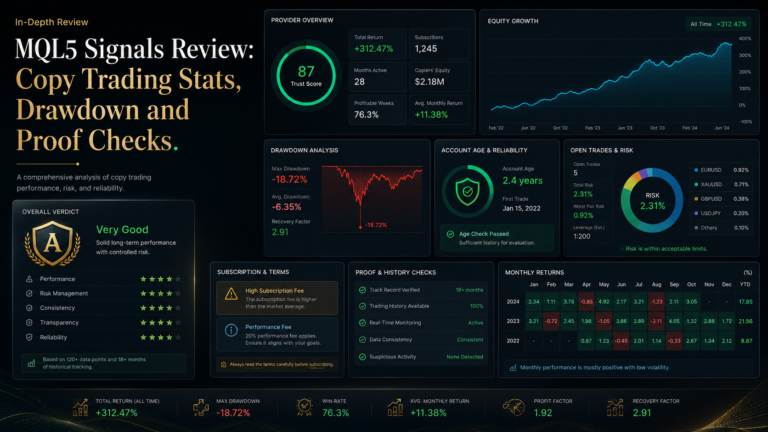
What This MQL5 Signals Review Covers
MQL5 Signals gives traders access to more than a chat feed of trade calls. Instead of screenshots, a subscriber can open a provider’s page and see growth, drawdown, balance history, deposit load and copying settings laid out in one place.
That transparency is genuinely useful, but it can also create a false sense of security, because a chart that looks smooth on the surface may still be built on risky position sizing underneath.
Before subscribing to any provider, the more useful question is not “how much has this account grown,” but “how much pain did this account absorb along the way?”
What This MQL5 Signals Review Checks
This MQL5 Signals review focuses on the checks that matter most before copying a provider:
- how visible the provider’s proof history actually is
- how copy trading signals are structured and delivered
- which signal provider stats are worth trusting
- how trading drawdown compares with reported growth
- account age and the number of trades behind the numbers
- deposit load and leverage
- open trades and floating risk
- subscription cost versus realistic account size
- whether performance looks repeatable or simply lucky
These checks matter because copy trading can feel passive. A subscriber is not placing each trade by hand, but the account is still fully exposed to another person’s decisions.
What MQL5 Signals Appears to Offer
The MQL5 Signals marketplace lets traders browse provider profiles and subscribe to copy trading signals directly inside MetaTrader. The official MetaTrader Signals help pages describe the feature as a way to mirror a provider’s trades automatically while reviewing that provider’s statistics beforehand.
Before subscribing to anything, it is worth reading the MQL5 Signals rules directly, since the copying terms and subscription conditions are spelled out there rather than in any single review.
This is what separates MQL5 from a typical Telegram channel: a marketplace structure, ongoing provider monitoring, published statistics and copying handled at the platform level rather than by hand.
Traders tend to turn to MQL5 Signals when they want:
- MetaTrader signal providers with a track record
- copy trading built into MT4 or MT5
- published signal provider stats rather than screenshots
- growth and drawdown charts side by side
- a subscription model instead of free-form alerts
- automatic copying instead of manual order entry
How useful any of this is still depends on whether the trader can read the statistics correctly. A profile can look strong at a glance and still carry risk that only shows up once the drawdown column is examined closely.
Why Signal Provider Stats Need Context, Not Just Confidence
Structured numbers beat random screenshots, but they are not automatic proof of a safe strategy. A provider can post solid recent gains that came from unusually high leverage, one favorable market stretch, oversized positions, or averaging into a loss until it eventually recovered.
Chasing the largest headline gain is the wrong instinct. The more productive habit is asking how that gain was actually produced.
Worth checking before copying anyone:
- How old is the account, and how many trades sit behind the stats?
- What is the maximum drawdown on record?
- Does the equity curve look smooth, or does it spike and crash?
- Are there large floating losses on open positions right now?
- Is the provider using unusually high leverage?
- Does performance depend on one instrument or one type of market?
- Does the provider recover from losses by increasing size?
The account with the best-looking chart is not automatically the safest account to copy.
Trading Drawdown, Growth and Account Age
Trading drawdown is arguably the single most important number in any copy trading signals review. Growth shows what happened when trades went right. Drawdown shows what happened when they did not.
A provider with fast growth and heavy drawdown can be a far riskier follow than a provider with slower, steadier gains and a controlled equity curve.
Account age matters just as much. A few strong weeks does not carry the same weight as many months of consistent performance across different conditions, because a short track record simply has not been stress-tested yet.
It also pays to check whether a provider tends to hold trades open for long stretches, averages down into losers, or is sitting on unrealized losses that never make it into the headline growth figure.
Signal Provider Stats Traders Should Not Skip
Reviewing MQL5 signal provider stats should never stop at the profit percentage. A fuller risk picture requires looking at several figures together.
1. Drawdown
Large drawdown swings signal that an account can experience painful dips, which may not suit traders running smaller balances or a lower risk tolerance.
2. Account Age
More history means more data points. A brief track record has not yet proven it can hold up across different market phases.
3. Deposit Load and Leverage
Heavy exposure can make an equity curve look exciting right up until the market turns against the provider.
4. Open Trades
Positions still open can carry floating risk that a simple win-rate or growth figure does not capture.
5. Trading Style
Scalping, grid systems, martingale-style recovery, swing trading and news-based trading all carry very different risk profiles from one another.
6. Subscription Cost
A monthly fee only makes sense once a trader understands the copying risk involved, broker compatibility, and the account size actually needed to follow the strategy properly.
MQL5 Signals vs Telegram Signal Groups
MQL5 Signals and Telegram groups shouldn’t be judged by the same yardstick. A marketplace profile typically shows more structured statistics, while a Telegram group tends to lean on alerts, screenshots, VIP posts and recap messages. For a closer look at that side, read Telegram Signal Reviews and VIP Signal Groups.
That doesn’t make MQL5 automatically the safer option. Structured statistics still require interpretation. It simply means the type of proof available is different.
With MQL5, the checklist runs through drawdown, equity, balance, deposits, account age and provider behavior over time. With Telegram, the checklist runs through original signals, timestamps, losses, edited messages and whether results are shown selectively.
Both formats call for skepticism. They just tend to fail in different ways.
Red Flags to Verify Before Copying a Provider
- A very short account history paired with aggressive growth
- High drawdown relative to the monthly return
- Large floating losses or trades held open for a long time
- An unclear or unexplained trading style
- Heavy concentration in a single instrument
- High leverage or deposit load
- Sudden growth spikes with little explanation
- Subscription pricing that only makes sense with an unrealistic account size
If several of these show up on a provider’s page, it is worth slowing down before subscribing.
FAQ: MQL5 Signals Review
What is MQL5 Signals?
MQL5 Signals is a MetaTrader-connected marketplace where providers publish trading statistics and traders can subscribe to copy those trades into their own accounts.
Are MQL5 Signals safer than Telegram signals?
Not automatically. MQL5 tends to show more structured provider statistics, but a trader still needs to check drawdown, account age, leverage, open trades and the real copying risk.
What is the most important MQL5 signal stat?
Drawdown is one of the most telling figures, since it shows how much stress an account has already absorbed.
Should beginners copy MQL5 signal providers?
Beginners should proceed carefully. Copy trading still exposes an account to losses, leverage risk, slippage and decisions made entirely by someone else.
What should traders check before subscribing?
Drawdown, growth history, account age, trading style, open trades, subscription cost, broker compatibility, and whether the provider’s risk profile actually fits the trader’s own account.
Final Thoughts
MQL5 Signals gives traders more structure than most screenshot-driven signal groups, but structure is not a guarantee of safety.
A copy trading profile can post strong growth and still be hiding meaningful risk. Drawdown, account age, open positions, leverage, deposit load and trading style all belong in the same conversation.
Before subscribing to any provider, the question worth asking is whether the signal history reflects controlled risk or just an attractive return. For more comparison-led coverage, visit Market Insights & Trading Signal Guides or read Trading Signal Comparisons.
If a provider believes any information here is outdated or incomplete, they are welcome to contact AISignalsBot with public proof, updated terms, or a reviewable track record.