
VIP Signal Groups: 7 Checks Before Joining StratoSig, Arthur Signals and SignalXpert
VIP signal groups are often discovered through Telegram ads, forwarded screenshots, private chats, or dramatic trade-result posts. A trader sees the promotion, searches the name, and tries to work out whether the group looks real enough to join.
That is the point of this article. It is not here to call a provider good or bad based on one post, one ad, or one screenshot. The goal is to show what is visible, what is missing, and what readers should verify before paying for access to a Telegram signal group, AI signal platform, or VIP trading channel.
This guide looks at names traders may come across, including StratoSig, Arthur Signals, Infinity Signals, SignalXpert, Learn2Trade, CryptoSignals.org, AltSignals, FXLeaders, 1000pip Builder, ForexSignals.com, MQL5 Signals, Zignaly, and BotPredictAI as a dashboard-style alternative.
This is not financial advice, and it is not a recommendation to join or avoid any specific service. Telegram signal reviews should help readers ask better questions before they pay.
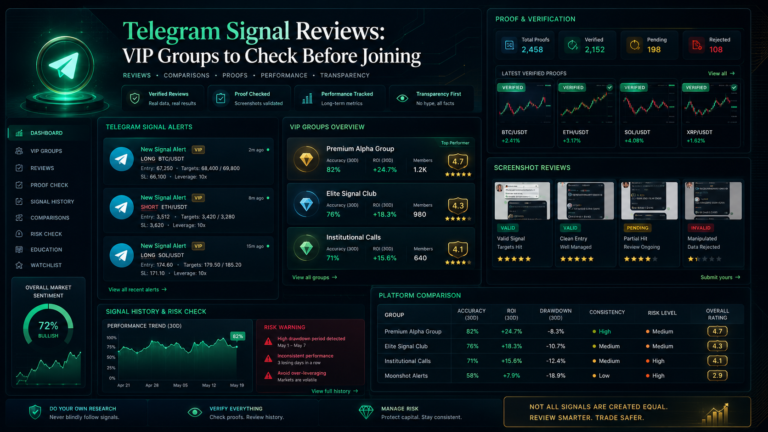
Why VIP signal groups need more than screenshots
Telegram makes signal services easy to market. A provider can post a trade idea, a chart, a profit screenshot, or a daily recap in seconds. That speed is useful, but it also creates a proof problem.
A screenshot can look convincing without answering the most important questions:
Was the trade live, demo, copied, edited, or selectively shown?
Was the original signal posted before the move?
Were the entry, stop loss, take profit levels, and timestamps visible?
Were losing trades shown with the same visibility as winning trades?
Was the account size realistic for normal users?
Was the position size, margin, leverage, and risk clear?
Is there a public closed-trade history outside Telegram screenshots?
Those checks matter because screenshot proof is not the same as a reviewable track record. A serious Telegram signal review should look at the whole proof style, not only the most impressive result post.
Telegram signal reviews: visible flags to check first
Before joining any VIP signal group, readers should slow down and check the visible flags. These flags do not automatically prove that a service is bad. They show where more verification is needed.
Screenshot-only proof: if a provider mainly posts screenshots, readers should ask whether the results are independently reviewable. Screenshots alone do not confirm whether positions were live, demo, copied, edited, delayed, or selectively posted.
No full signal history: a few winning posts do not show the complete picture. Readers should look for original signals, closed trades, losses, open trades, timestamps, and a consistent archive.
Large balances or unrealistic position sizes: big account screenshots can attract attention, but they need context. Account type, leverage, margin, trade size, and duration should be clear.
No visible losses: every real trading approach has losing trades. If a channel only shows wins, the history is not easy to judge.
Reaction farming: posts like “hit this many reactions and I’ll drop a trade” are engagement tactics. They may build excitement, but they do not prove signal quality.
Private pricing or unclear support: if users must message a bot or private admin before seeing basic terms, pricing, cancellation rules, or refund details, that should be checked carefully.
StratoSig: AI signal claims and what readers should verify
StratoSig presents itself as an AI-driven crypto and gold signal platform. Its public site describes entries, targets, defined stops, confidence scores, time horizons, invalidation levels, and a paper-trade scoreboard.
That is a stronger public structure than a basic Telegram-only group because it frames the product around signal parameters and a track-record concept. But readers should still verify how much of that record is actually reviewable before relying on the claims.
Important checks for StratoSig include:
Can users see recent closed signals before paying?
Are losing trades shown clearly?
Are original entries, stops, targets, and timestamps visible?
Is the paper-trade scoreboard easy to audit?
Does the scoreboard show enough recent history to judge performance?
Is the platform clear about simulated or paper-trade results versus live results?
The main reader check is simple: StratoSig has a clearer product description than many Telegram ad funnels, but the proof still needs to be inspected. A confidence score, invalidation level, or paper-trade record is useful only if the history is visible enough to judge.
Arthur Signals: screenshot proof needs context
Arthur Signals is a Telegram signal channel that appears publicly active and uses trade-result style posts. The visible format includes signal messages, reaction-heavy posts, and screenshots that show positions, balances, profit and loss, leverage context, and trade updates.
That kind of content can look impressive, but readers should treat it as a proof claim, not proof by itself.
When a Telegram channel shows large account balances, high position sizes, short trade updates, and big result screenshots, readers should ask whether those positions are live, demo, copied, edited, or selectively shown. They should also check whether the original entry was posted before the trade moved, whether the stop loss was included, whether losing trades are shown, and whether the channel keeps a complete closed-trade history.
Specific flags readers should check with Arthur Signals-style posts include:
Large visible account or position sizes without enough account context.
Short-duration proof posts that may not show the full trade lifecycle.
Reaction requests before signal drops.
No obvious independent tracker attached to the Telegram channel.
Unclear difference between signal result screenshots and full performance history.
This does not mean every post is false. It means the proof style should be reviewed carefully. A screenshot can support a claim, but it should not replace original timestamps, closed history, losses, and clear trade context.
Infinity Signals: big public claims need full history checks
Infinity Signals presents itself as a crypto Telegram signal service with premium plans, daily signal volume, Cornix automation support, public performance claims, and a performance or history link.
The public page uses strong claims, including large member counts, frequent daily signals, high win-rate language, thousands of trades, leverage-based profit-potential language, and premium pricing. Claims like that are exactly why readers need to look beyond the headline numbers.
Before joining, readers should check whether the performance history shows:
Original signal entries.
Take-profit levels and stop losses.
Closed trades and losing trades.
Timestamps from the original signal, not only recap posts.
Leverage context and exchange context.
How results are calculated.
Whether verification is independent or controlled by the provider.
The biggest issue with any high-performance crypto signal page is not whether the numbers look attractive. It is whether a normal reader can audit the path behind those numbers. If a service says results are transparent, readers should be able to inspect the full history, not only selected highlights.
SignalXpert: daily recaps are not the same as full verification
SignalXpert presents itself as an AI-powered trading signal and market intelligence platform. Its public messaging uses strong language around real-time signals, AI market analysis, verified signals, and profitable trade ideas.
That makes it useful for readers to compare, but it also creates a proof question. A daily recap, winning result summary, or large pip or profit claim is not the same as a full track record.
For SignalXpert-style result posts, readers should check:
Whether original signals are visible before the result recap.
Whether losing trades are shown alongside winners.
Whether the recap includes entries, stop losses, targets, and timestamps.
How pip totals or percentage totals are calculated.
Whether crypto, forex, metals, and indices are separated by asset type.
Whether performance claims are independently verifiable.
A result recap can be useful, but only if it connects back to a reviewable trading history. Readers should avoid judging any service only by one strong day, one screenshot, or one summary post.
Learn2Trade, CryptoSignals.org and AltSignals: Telegram delivery checks
Learn2Trade, CryptoSignals.org, and AltSignals are useful comparison points because they sit closer to the Telegram or VIP signal model than scanner-only tools.
For these types of services, the main question is not only whether signals are sent. Readers should check how the signals are delivered, how frequent they are, how performance is shown, and whether the group experience creates more structure or more pressure.
Important checks include:
Does the provider show a complete signal history?
Are losses included?
Are Telegram updates clear and timely?
Are renewal and refund rules visible before payment?
Does the group push users toward high-risk trading behavior?
Does the service explain risk per signal, or only entries and targets?
Telegram delivery can be useful for fast alerts, but fast delivery does not automatically mean better signal quality. The signal still needs context, risk controls, and a reviewable history.
FXLeaders, 1000pip Builder and ForexSignals.com: signal plus research models
FXLeaders, 1000pip Builder, and ForexSignals.com fit a slightly different category. They are not only Telegram ad funnels. They are closer to signal, education, research, or community-style platforms.
That can be useful for readers who want more than a short alert. But the same review standards still apply.
Readers should check:
What is free versus paid.
Whether premium access reveals the full trade details.
Whether historical performance includes losing periods.
Whether signals are supported by analysis or only alerts.
Whether support, pricing, and cancellation terms are easy to find.
Signal-plus-research platforms can be more transparent than private VIP Signal groups, but readers should still avoid assuming that a polished website equals a verified record.
MQL5 Signals and Zignaly: copy-style alternatives need different checks
MQL5 Signals and Zignaly are not the same as a normal Telegram VIP Signal group. They sit closer to marketplace, copy-trading, or strategy-following models.
That changes the review process. Instead of only checking a Telegram channel, readers should inspect strategy history, drawdown, account age, open trades, copying rules, fees, and whether the trader or strategy is still active.
For copy-style platforms, readers should check:
How long the strategy has been active.
Maximum drawdown.
Open trade exposure.
Closed trade history.
Fees or profit-sharing structure.
Whether results are live, demo, or simulated.
A marketplace can make performance easier to inspect, but it does not remove risk. Readers still need to understand how the results were created.
BotPredictAI as a dashboard alternative
BotPredictAI is different from a Telegram-first signal group. It is better understood as a dashboard-led AI signal platform with signal coverage, market categories, and visible result checks.
That makes it useful as a comparison point. Some readers may prefer a VIP Signal group because they want messages sent directly to them. Others may prefer a dashboard where they can review signal history, categories, limits, and recent results before deciding whether the workflow fits.
The reader check is still the same: look for recent results, visible losses, supported assets, signal limits, delivery channels, and plan terms. A dashboard can create more structure, but readers should still verify whether the signal history is enough to judge.
What a real Telegram signal review should include
A useful Telegram signal review should not only ask whether people are talking about a channel. It should ask whether the service gives readers enough information to judge before joining.
At minimum, readers should look for:
Original signal posts.
Entry price.
Stop loss.
Take-profit levels.
Timestamped updates.
Closed trade history.
Losing trades.
Clear pricing.
Refund or cancellation terms.
Support contact visibility.
If those pieces are missing, the reader should be careful. Missing proof does not automatically mean a service is bad, but it does mean the service is asking for trust before showing enough reviewable evidence.
Final thoughts
Telegram signal reviews are most useful when they focus on visible checks instead of hype.
A strong signal provider should make it easy for readers to understand what is being offered, how signals are delivered, how past trades are shown, what losses look like, and what happens after payment. A weak review process ignores those questions and only reacts to screenshots, emojis, and winning posts.
The safest way to compare Telegram VIP Signal groups is to separate claims from proof:
A screenshot is a claim.
A daily recap is a claim.
A big win post is a claim.
A full timestamped history is stronger evidence.
Losing trades make the history more reviewable.
Clear pricing and cancellation terms build trust.
If a provider believes information is outdated or incomplete, they can contact AISignalsBot with public proof, updated terms, or a reviewable track record. For more comparison-led articles, use the Market Insights & Trading Signal Guides hub.